
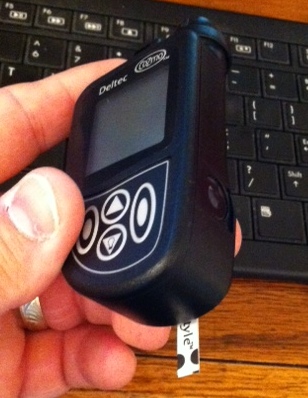
Basketball and Temporary Rates
Does the body become accustomed to exercise, requiring less and less of a temporary basal rate over time?
When playing basketball was new, my temporary rate was pretty aggressive. And it seemed to work pretty good.
But lately I have been running higher and higher during and afterwards – so I’ve begun to wonder if my temporary basal rates are just not cutting it for me anymore? Has my body become accustomed to basketball, and is no longer needing me to set such an aggressive temporary rate?
And if so, what happens if I take a couple weeks off? Falling a bit out of shape, then starting back up again – will I be back where I started, or where I left off, or somewhere in the middle?
Or, another thought – what if it is something else altogether? Nothing at all to do with my temporary rates?
Hmmm…

14 Responses to Basketball and Temporary Rates
Leave a Reply Cancel reply
Scott K. Johnson
Diagnosed with type 1 diabetes in April of 1980, I recognize the incredible mental struggle of living with diabetes.
| About | Contact | Hire | Disclosure |Scott's Contest Entry - Watch to Vote!
I need your help - please watch and share! Unique views = votes! Thank you!
Scott on Twitter
- @DiabetesInno @Diabetes_Sanofi Thanks for the mention! 03:06:25 PM June 18, 2013 in reply to DiabetesInno
- @lrkrueger @MichelleMile23 Awesome! It will be awesome to meet her! 02:59:46 PM June 18, 2013 in reply to lrkrueger
Favorite Quotes
“Diabetes is like being expected to play the piano with one hand while juggling items with another hand, all while balancing with deftness and dexterity on a tightrope”
— Marlene Less, 1983
Disclaimer
I am not a medical professional. Nothing on this site should be construed as medical advice. Your diabetes may vary. Contact your health care provider for specific questions.
Now Co-Hosting DSMA Live!

Paid Advertisement
Interested? Contact Scott.


Hey Scott,
They say that over time the body gets used to what muscles you use and so therefore you don’t need as much glucose to repair them after sport etc….so therefore you need less of a TBR. I found that when I got uses to cycling 1/2hour each day I didn’t need to lower my basal as much. Then when I started a new exercise using different muscles then I needed to lower my basal again.
Or maybe it’s nothing to do with it as you say….. :O) that’s diabetes for ya,
love Vic x
If only I had muscles I might have an answer for you.
I swear, there needs to be a diabetic Psychic Friend out there we can hook up with. that would be awesome! How the hell are we supposed to know this stuff? Sorry to use this as a mini rant but I get frustrated how one thing works today and doesn’t tomorrow. LAME!
That’s it, i am calling Dionne Warwick right now!
I guess the obvious thing would be to experiment with the rates and see what it gets you.
Or look up articles about exercise and diabetes and see what the dynamics are.
Scott,
I can imagine that after playing basketball at a regular time period daily would cause you to not have to expend as much energy to do the same things. Perhaps that is something you are noticing. Another thing to consider though, is the difference between the effect that anaerobic and aerobic exercise have on your blood glucose levels. Anaerobic would be sports like hockey, or activities like weightlifting, where you have short and intense bursts of activity. Aerobic would be something more along the lines of a cardio machine, running, or brisk walking. Anaerobic exercise is treated at the base metabolic level by your body differently than aerobic exercise, and results in blood sugars rising. Aerobic exercise will result in a lowering of blood sugar. The problem in understanding and using this info lies in learning to distinguish whether your body is perceiving something as an anaerobic exercise or aerobic exercise (and this can vary w/in the same workout), how to predict responses, and how to guage during your workout if your blood sugar is actually rising or falling. I really really need to look into finding the article I have found in the past that very clearly (and with lots of medical terminology) describes what exactly is happening at the metabolic level in both instances.
Personally, I just think things change over time as your fitness levels increase or decrease, and as hormone levels increase or decrease (does that hormone thing even apply to men?).
Hi Scott,
All of this is discussed in the Diabetic Athlete by Sheri Colberg. Yes your body does get use to exercise, so you will need less of a temporary basal decrease. The book also discusses aerobic versus anaerobic exercise. Nevertheless there are no simple rules b/c you still have to test what works on your own body AND patterns do change….. Shall we call it a challenge? A big pain in the ass challenge!
Scott, I think I have the answer! If we will all just do the same damn thing and eat the same damn thing every day with no variation, we will die of boredom and diabetes will no longer be an issue.
Hi Carol,
Your comment was worth a good chuckle! You hit the nail right on its head.
hi scott!
yeah ryan is a clever person to make logbook dm. i wouldn’t have a clue of where to start.
that’s for wishing me luck in getting the job. as soon as the application form comes and i send it off, i’ll be praying all the time, at least for an interview.
keep well.
vic x
HI Scott,
I enjoy reading your blog alot. It really shows on how technical of a life a diebetic leads. Although not directly applicable to me, but reading and following your blog gives me a really good sense of what Emma (my daughter) is going to have to face in her years to come. It is so promissing that this “community” is out there and how you all pull together for motivation and information. I’m really excited for Emma to be part of something this amazing in the years to come.
Take care,
Chris
Hi Scott,
There is a good deal of evidence to suggest that the body does become used to a certain recurring situation, therefore your basals may no longer require the reduction (or require less of a reduction) than they once did. The body is amazing, and doctors do not completely understand it. For example, with hypoglycemia, it was once largely believed that the brain required pure glucose to function. While that is true, the suspected damage once believed to be caused by hypos has thus far not appeared in any clinical findings. Basically, when the body becomes used to a certain state (whether its low blood glucose, or exercise), it adjusts to the situation accordingly. Keep in mind that basals are usually required to continue fueling the cells in a fasting state (between meals), and exercise means that the muscle cells require more fuel (glucose) to continue funtioning at that level, so you will probably require some basal insulin, the biggest question is, how much?
Thanks for your support with your comment on my site. I am going to add you to my list if that is cool.
Take care!
scott, you really should kick that diet coke habbit. the stuff sucks…… water is yummy, honestly… it will make you feel tons better :O)
vic x
Scott,
I’ll definitely get in touch with you when we go up for our next appointment. Why don’t you email me your email address? (mine is [email protected]) That way I can let you know when we’ll be up there? I’ve had the great opportunity to make some great autism contacts in the past few days, but it seems most autism specialists are in the cities,so I imagine the kids and I will be spending a lot of time especially in the next few months up there! Take care! (oh and we are a bk family, happy meals are soooooooo last year!)
hiya….
thanks, we’re all doing just fine! :O) roll on Friday though. I think booty might claw me in my sleep if I don’t get the dreaded cone off of her neck soon.
vic x